I love classical music, especially a cappella Russian liturgical music. I love to smell good; I think right now I have upwards of 10 different colognes that I switch up daily, depending on my mood, and a couple of them--GASP!!--are not made specifically for men. I have three times as many body and shower products as my female housemate. I love to cook and bake. I love to do crafts. I detest football (and most other sports). I was a professional ballet dancer. I love art museums and old architecture. I enjoy gardening. My voice is, I think, a little bit high. I am very emotional and nurturing.
Masculine? Feminine? What's my gender? And, more importantly, why are so many people obsessed about it?
I've already written about this, but when I came out and for the next 12-or-so years, I did all I could to distance myself from being perceived as gay, and specifically worked hard on anything related to masculine gender expectations: I consciously lowered my voice, and when I walked I was careful to keep my hips very still and to swing my arms straight forward and straight back. I squeezed extra firmly when I shook someone's hand. I watched men whom I thought were masculine and tried to copy their mannerisms. I convinced myself that my internalized homophobia was doing the gay community a favor. I was showing the world that not all gay people fit the stereotypes, knowing the whole time that, really, I was a walking stereotype in many ways. This made me hide parts of myself and lie a lot when I was around anyone except my closest friends. I didn't talk about how I was a ballet dancer. I highlighted the fact that I love camping and hiking and drinking beer and hid the fact that I love foreign films, 19-century British novels, and the occasional martini.
There were two distinct forces at play for all those years: my desire to be seen as "normal" despite my sexuality, and my obsession with being perceived as anything but what society calls feminine.
"What society calls..." That's the crux of the matter, I think. Who decided what "masculine" means? Who decided which qualities would be deemed "feminine"? Is there a masculine archetype, something I can go to in order to see "true" masculinity? Is there someone alive today who embodies all things masculine and can stand as a torch bearer for Real Men?
For some clues about the true masculinity, let's look to history.
Have you checked out Donatello's statue of David lately? This is David, yes, that David, the one who killed Goliath. Take a look...

Hmm... not exactly our modern idea of masculine, no? But it once was, at least it was in the mid-1400's. See how he is standing in repose, weight in the right hip, limp wrist resting on the other? See any humongous bulging muscles? And that hat!! This guy was a bad-@$$ killer?? If this statue was a real person today, he would totally get beat up every day at lunch.
The really famous statue of David, the one by Michelangelo, was sculpted around the year 1500. What's has changed here regarding masculine ideals?

He's got a little more definition in the torso muscles and much more defined arms. A rounder tush. He's got shorter hair and a bit more intensity in the face. But he's still sitting into that right hip. Still not super masculine by our standards.
Now check out Bernini's version, sculpted roughly 100 years later:
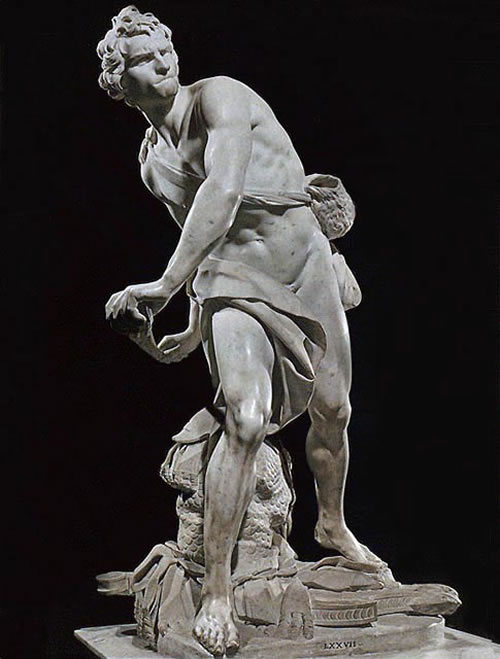
Ah. That's more like it. Now that dude is butch! This is a man of dominance and action. Check out those muscles. This dude totally works out. This is a guy who might kill a giant. Look at the tension in his eyes and mouth. See how he is twisted and poised for the kill?
But can we assess a time period's ideals of masculinity just by looking at a few statues?
From around the same time period as Donatello's David: behold and fear this noble warrior!!
"Umm, like, this helmet totally messes up my hair. And this breast plate makes me look fatter than King Henry VIII. Mind if I just set it on the floor behind me? That way, my hair can flow freely and the viewer can see how slender my waist is."
Did things change in the next 200 years?


Umm... it appears not.
In fact, it seems that men's and women's clothing and mannerisms were fairly similar, aside from the longer length of women's dresses, right up until the late 1700's and early-ish 1800's, when men's long jackets got shorter, cravats were tucked in, and knee breeches went out of style and were replaced with (fairly form-fitting) ankle-length pants. Nor is it fair to label earlier men's styles "feminine," as they certainly would not have defined them as such. They just were what they were. The lines between the genders (at least in mannerisms and clothing) were not as rigid as we've made them today. Gender roles in centuries past seemed to be more internal ones: chivalry, for example, was decidedly masculine. It didn't matter how the guy dressed as long as he rescued the damsel in distress, apparently.
 |
| Aherm... Yeah. Sexy, I know. *closes mouth* |
And what about babies? Today, we are unabashedly obsessed (and this, I firmly believe is not hyperbolic) with making sure that absolutely everyone knows if our newborn baby is a boy or a girl. It is marked within minutes of being born as one or the other. Parents now have to find out which sex the baby is so they can start grooming it for the proper gender role it must fulfill. Rooms are painted in pinks or blues. Frilly headbands are bought or made. Cute dresses are purchased for girls and cute little pairs of pants and overalls are bought for boys. But there was a time - and a lot more recent than you might think - when a baby was just a baby. All babies wore a long dress; that is, up until a certain age.

See what the toddler boy is wearing? And is that infant a boy or a girl??
With the rise of the middle class in Victorian England, the home became the domain of the woman. The man, bless his heart, had to go out into the wild, evil, sinful world and work. But the woman was blessed to stay protected inside her castle. According to John Ruskin, the preeminent Victorian art critic and social lecturer,
But we've moved beyond all that, right? Wrong.
We are still obsessed with linking our actions, thoughts, and interests with what is between our legs. People fear social upheaval if there is a blurring or mixing or (heaven forbid!) completely tossing aside of prescribed gender roles. And what's odd is that it tends to be pretty one-directional; that is, a woman can easily blend into things "masculine," as it is only natural that everyone alive should aspire to masculine ideals. As long as she doesn't appropriate too much masculinity: "bull dyke" is an appellation that has few, if any, positive connotations in our culture. A girl who is a tomboy is cute, is praised, even. But a boy who plays with dolls is reviled. In fact, a boy who dares venture even the tiniest bit into the realm of the feminine is teased, beaten up, called demeaning names, hated, and ostracized. There is nothing worse, it seems, than being a woman. (Interestingly, I hear very often women say to each other things like, "You need to grow a pair" or "You just need to man up." Amazing how subconsciously pervasive internalized misogyny is, I think.)
True, today we have our "metrosexuals," but that's really just a title that makes it okay for straight men to do things that are decidedly feminine: buying nice clothes, getting fashionable haircuts, getting manicures and pedicures, etc. And even that term is used these days, more often than not, as a pejorative. My students, both males and females, are shocked to discover that I do not watch football, that I didn't do the March Madness thingie. But some of them are equally shocked to discover that I used to be a ballet dancer and that I enjoy cooking. I had one male student say, "I bet all the ladies love when you cook for them."
Do we need to be so easy to figure out? What is the harm in doing what we love and acting the way that feels natural to us? Is it so terrible to be a straight woman who is mistaken as a lesbian or a straight man who is mistaken as gay? Must it rock our world to be asked by an admirer if we share that person's sexual orientation? There are an awful lot of people who genuinely fear and loathe any blurring of gender lines. Just look at the LDS church I was raised in: they currently teach children a primary song that talks about how men are intended to be the providers and women are intended to be the nurturers. There is, of course, nothing wrong with a man who is "the" provider, nor is there anything wrong with a woman who is a nurturer. But what is inherently masculine about providing, feminine about nurturing?
I've heard female friends praise their boyfriends or husbands like this: "I just love how he doesn't mind watching romantic comedies with me!" or "My husband is a better cook than I am!" Maybe your boyfriend likes romantic comedies. Is that so bad? What is inherently feminine about romantic comedies? What is inherently feminine about cooking? Why are these things that need to be pointed out as if they are complete oddities and anomalies?
I've heard men say things like, "My wife is more into football than I am!" Can't she like football? What is inherently masculine about football?
Creating and enforcing roles makes us into nothing more than actors. And even if it is true that "all the world's a stage," shouldn't we at least be able to choose our own attributes, ones that are an accurate reflection of who we are on the inside? And shouldn't those roles be celebrated and embraced?


I was just thinking about this the other day. It irritates me that society thinks this way. My personal example is that I sometimes dress in tank tops and pants that show my figure, (I'm a female) I've heard people in the gay community tell me, "You don't appear gay". It's like REALLY? Do I have to dress butch to be a lesbian? My sexual attraction to women has nothing to do with the way I feel like dressing. Also there is a problem with society when people are getting bullied or abused by the way they dress or act, even children Anyway, thanks for shining light on this subject. I've already shared it with a few of my dear friends! <3
ReplyDeleteMy thoughts exactly! The fact that I'm gay has nothing to do with how I dress or act. Thanks so much for your comment and for sharing part of your story. :)
Delete